Case study 04
Virtual Try-On
Taking an eyewear experience from product discovery and vendor evaluation through launch
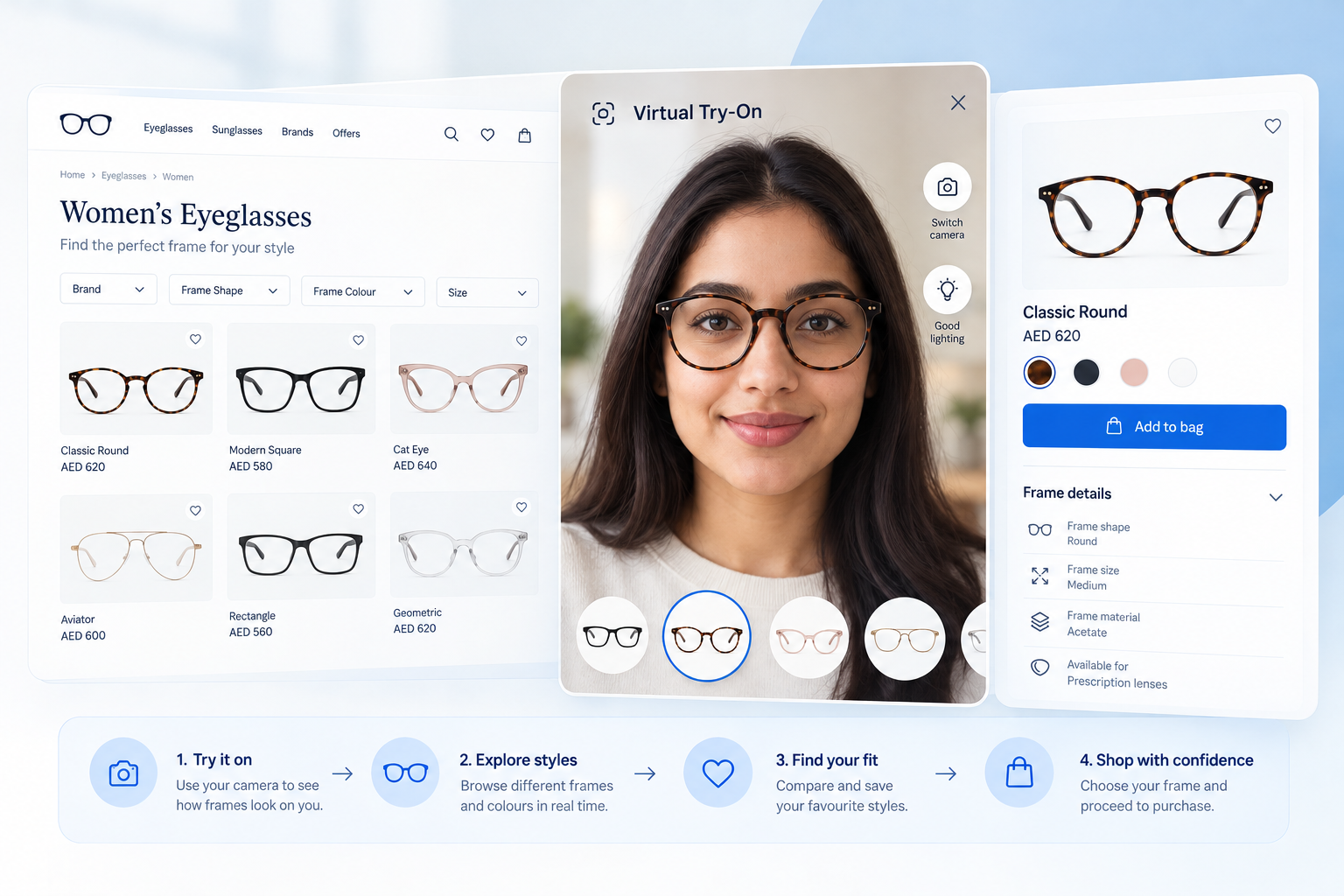
- Role
- Product Manager / Product Owner
- Team
- Product · Client Business Team · UX · Development · QA · External VTO Provider
- Timeline
- Approximately 3 months
- Focus
- Discovery · Vendor Evaluation · UX Collaboration · Requirements · Integration · Testing · UAT · Launch
01
The challenge
For eyewear, one of the biggest barriers to online purchase was confidence.
The business had a long-established physical retail presence but was relatively new to e-commerce. For customers accustomed to trying eyewear in-store, purchasing sunglasses or eyeglasses online required a significant change in behaviour.
The challenge was particularly important for prescription eyeglasses. Customers needed confidence not only in the frame itself, but also in how it would look on them before committing to a personalised prescription purchase that could not be returned.
With sunglasses and eyeglasses forming key product categories, we wanted to explore how the online experience could reduce some of that uncertainty and give customers greater confidence when choosing frames.
“Will this suit me?”
Unable to physically try the frame
Lower confidence purchasing online
02
The product opportunity
Virtual Try-On emerged as a potential way to bridge part of the gap between the physical and digital eyewear experience.
Rather than asking customers to choose frames based only on product photography, VTO could allow them to see an approximation of how a frame would look on their own face before deciding whether to purchase.
Before selecting a solution, we explored how other eyewear businesses were approaching Virtual Try-On and reviewed the quality, precision and customer experience of existing implementations.
- 01
Customer barrier
- 02
Explore VTO opportunity
- 03
Review market experiences
- 04
Evaluate potential solutions
03
Vendor evaluation & selection
Rather than selecting a Virtual Try-On solution based on a demo alone, we used a structured evaluation process to compare potential providers against the needs of the e-commerce experience.
5potential solutions were evaluated.
My contribution included
- Participating in vendor demos and discussions.
- Testing available demo experiences.
- Working with the client Product Owner and e-commerce team to evaluate the solutions.
- Discussing technical requirements and integration considerations with vendors.
- Considering commercial requirements alongside product and technical fit.
- Documenting the pros and cons of the different options.
- Contributing to structured scoring and the final recommendation.
Evaluation framework
- Customer experience
- VTO quality · Accuracy · Fit/measurement · Overall experience
- Technical fit
- Integration flexibility · Platform capability · Technical support
- Operational fit
- Existing 3D assets · Manual effort · Ability to support the required experience
- Commercial fit
- Solution and implementation considerations
5 solutions evaluated
Experience · Technical · Operational · Commercial
Structured assessment & trade-offs
Recommended solution
Evaluation framework simplified for confidentiality. Vendor scores and commercial details are not shown.
Making the recommendation
The selected solution did not win simply by having every possible feature.
One of the trade-offs was that it did not support contact-lens Virtual Try-On, while some alternatives did. However, eyewear VTO was the primary requirement, and the selected solution performed strongly across the factors that mattered most for the intended experience and business context.
The evaluation considered areas such as VTO precision, fit and measurement capability, platform maturity, technical support, availability of reusable 3D assets and the operational effort required to maintain the experience.
“The decision was based on the best overall fit for the primary customer need and business context, rather than selecting the solution with the longest feature list.”
04
Designing the VTO experience
Once the provider was selected, the next challenge was deciding how Virtual Try-On should fit naturally into the e-commerce journey rather than existing as a standalone feature customers might never discover.
I worked closely with the client and UX designer to define where VTO should appear and how customers should encounter it across the shopping experience.
My contribution
- Worked with the client to clarify expectations for the VTO experience.
- Collaborated closely with the UX designer on how the functionality should appear within the existing e-commerce journey.
- Helped define the key VTO entry points across the dedicated VTO landing experience, Product Listing Page (PLP), and Product Detail Page (PDP).
- Reviewed UX designs and provided product feedback.
- Demoed the proposed experience to the client, gathered feedback and supported design sign-off.
- 01
Discover frames
- 02
Try virtually
- 03
See the frame on your face
- 04
Explore / compare options
- 05
Continue toward purchase
VTO Landing Page · PLP · PDP
05
From product definition to integration
Once the VTO experience and provider were agreed, my role shifted from product discovery and selection into delivery and integration coordination.
I owned the functionality from the product side, translating the agreed experience and third-party requirements into work the delivery team could implement.
My role during delivery
- Created user stories and acceptance criteria for the VTO functionality.
- Groomed the stories with the development team and clarified expected product behaviour.
- Worked directly with the VTO provider's point of contact to understand integration requirements and dependencies.
- Translated and shared relevant third-party requirements with the development team.
- Coordinated between the vendor, developers, UX and client stakeholders as implementation progressed.
- Helped clarify and unblock integration issues where coordination or product decisions were required.
- Ensured implementation remained aligned with the agreed customer experience across the VTO landing page, PLP and PDP.
External VTO Provider
Product
Requirements · Coordination · Decisions
UX · Development · QA · Client
Engineering teams owned the technical implementation. My role was to provide product ownership and coordination across the teams involved.
- 01
Vendor selected
- 02
Experience agreed
- 03
Stories defined
- 04
Integration requirements aligned
- 05
Development
- 06
Testing
06
Testing, UAT & launch
Testing was especially important because the customer experience depended on an integration between the e-commerce platform and an external VTO provider.
My involvement continued across the testing stages rather than ending with development.
My role in validation
- Coordinated integration-level testing between the VTO provider and development team.
- Participated in SIT alongside the QA/testing team.
- Tested the functionality from the product perspective, including the agreed customer journeys and VTO touchpoints.
- Demoed the completed functionality to business stakeholders.
- Supported the business team during UAT, helping clarify expected behaviour and address issues or questions.
- Coordinated across the vendor, development and testing teams as issues were identified and resolved.
- Supported readiness for launch.
- 01
Vendor + Developer Testing
- 02
SIT
- 03
Business Demo
- 04
UAT
- 05
Launch
Launch
After approximately three months from discovery through delivery, Virtual Try-On was launched to customers in a single-phase release.
The launch represented the completion of an end-to-end product journey that began with understanding a customer purchasing barrier and progressed through market research, vendor evaluation, product definition, third-party integration, validation and release.
07
After launch
The functionality launched with minimal issues and provided customers with a new way to explore eyewear online before making a purchase decision.
Post-launch analytics provided through the VTO solution showed increasing usage of the functionality over time. Positive movement was also observed in the online sunglasses and eyeglasses categories following launch.
No quantitative performance figures are included because the historical analytics are not available for this case study.
08
What I learned
The best solution isn't necessarily the one with the most features.
The vendor evaluation reinforced the importance of balancing customer experience, technical fit, operational effort and commercial considerations. A solution can have capability gaps and still be the right choice when it best addresses the primary product need and business context.
Third-party products still require strong product ownership.
Selecting an external solution did not remove the need for product definition. The experience still had to be integrated into the customer journey, translated into stories, aligned with UX, coordinated across teams and validated end to end.
Integration products depend on collaboration across organisational boundaries.
Working across the client, UX, development, QA and external VTO provider made clear requirements, ownership and communication particularly important from discovery through launch.
The product journey
Customer purchasing barrierVTO opportunityMarket researchVendor evaluationVendor selectionExperience definitionIntegration & deliveryTesting & UATLaunch