Case study 05
Membership Digital Platform
Transforming manual membership operations into a connected digital experience
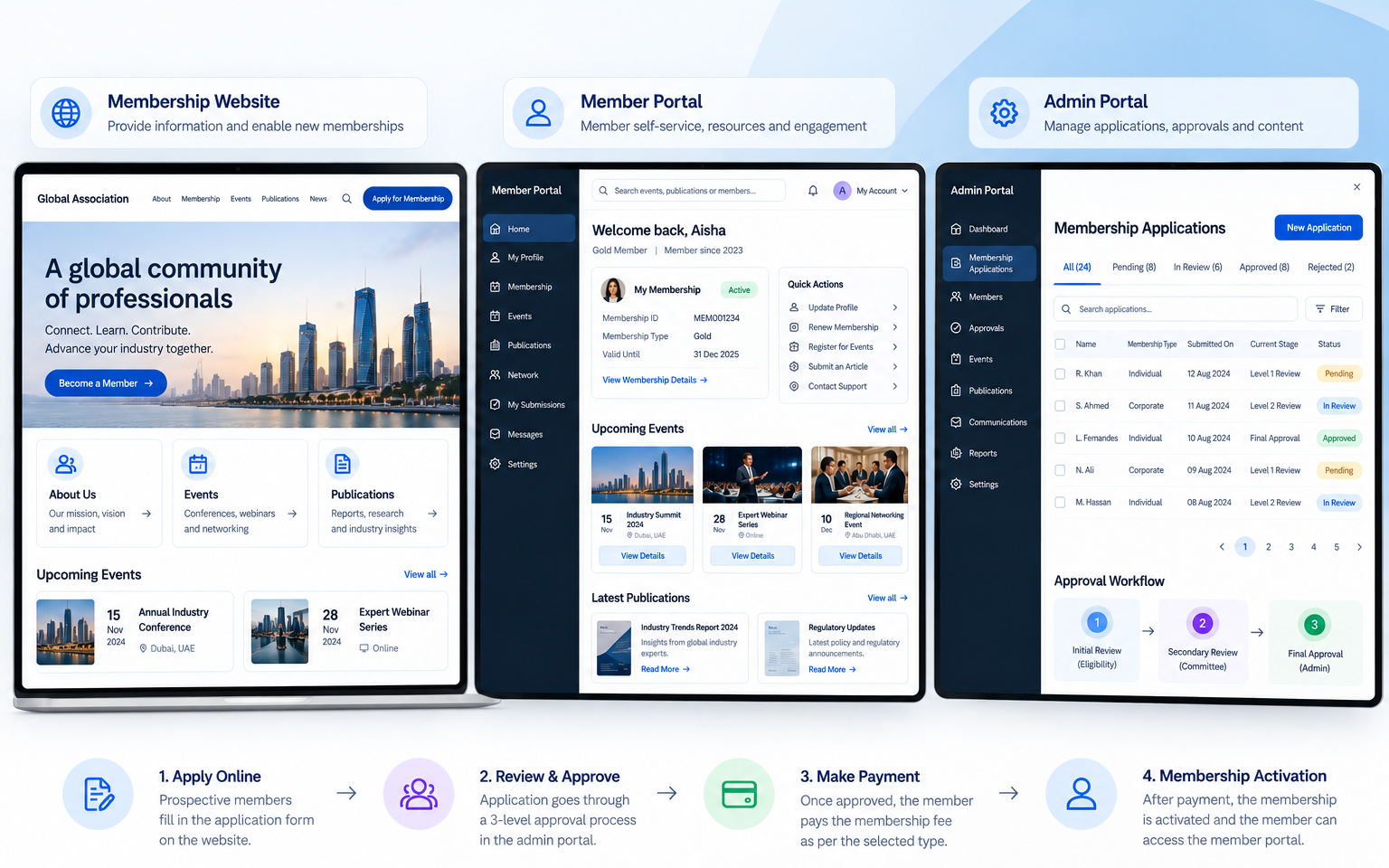
A digital transformation initiative for an international membership organisation.
- Role
- Product Manager / Product Owner
- Duration
- Approximately 7–8 months
- Scope
- Public Website · Member Portal · Internal Admin Portal
- Focus
- Product Discovery · Process Digitisation · Requirements · Workflow Design · UX Collaboration · Delivery · UAT · Launch
- Supporting integrations
- Strapi CMS · Payment Gateway · Email
01
The challenge
Membership operations relied heavily on manual processes across forms, spreadsheets and email.
Membership applications were submitted through online forms, but the information then had to be downloaded and managed manually. Applications moved through a three-level approval process using spreadsheets and email, creating significant administrative effort for the business team.
At the same time, members had limited opportunities for digital self-service.
The challenge was to transform both the internal membership operations and the way members interacted with the organisation.
Simplified previous workflow
- 01
Online Form
- 02
Manual Download
- 03
Spreadsheet Tracking
- 04
Email Coordination
- 05
Multiple Approvals
- 06
Membership
02
Reimagining the membership journey
The opportunity was to create a connected digital experience spanning membership applications, approvals, payments, member self-service, engagement and ongoing administration.
The transformation involved three connected experiences.
- Public Website
- Member Portal
- Internal Admin Portal
- Public Website
- Supported membership discovery, registration, public member information, events, news and other content.
- Member Portal
- Enabled approved members to manage their information, access exclusive resources, connect with other members and interact with the organisation.
- Internal Admin Portal
- Enabled business teams to manage applications, approvals, member information, payments, content governance and access rules.
The objective was not simply to replace an online form. It was to connect the different stages of the membership lifecycle within a more structured digital experience.
03
Two sides of the same product
Member Portal
Empowering members
Manage My Presence
- Update member and company profile information
- Manage services, links, photos and logos
- Maintain information displayed on the public member profile
Connect
- Connect with fellow members
- Chat with other members
- Communicate with the organisation's admin team
Access Member Benefits
- Access exclusive publications and reports
- Explore member resources and the media library
Contribute
- Create events
- Submit news and other content
- Send contributions for business review before publication
Admin Portal
Managing membership operations
Membership Operations
- Manage membership applications
- Support three-stage approval and rejection
- View member details and records
- Filter members by membership type
Payments & Rules
- Initiate payment links following application approval
- Manage payment-related rules
- Manage tax rules
Member & Content Governance
- Review and approve or reject member profile changes
- Review member-created events, news and content
- Manage enquiries and responses
Access & Configuration
- Control website page access for guests and three membership types
- Configure registration form fields
The two portals supported the same membership lifecycle: giving members greater self-service while providing the business with the controls needed to manage approvals, content, payments and access.
04
Digitising the membership & approval journey
A significant part of the product work involved translating an existing manual approval process into a structured digital workflow.
The organisation supported three membership types, each following a three-level approval process.
Simplified membership workflow
- Approval Level 1
- Approval Level 2
- Approval Level 3
Approved
- Payment Link Initiated
- Payment
- Membership Activated
- Member Portal Access
Rejected
Does not proceed to payment.
My product contribution
- Worked with business stakeholders to understand the existing process
- Mapped application, approval and post-approval journeys
- Translated business rules into workflows, requirements and user stories
- Clarified expected behaviour across approval stages and membership types
- Collaborated with UX to translate workflows into portal experiences
- Worked with engineering to clarify requirements during implementation
- Participated in testing and supported business UAT
- Payment Integration
- Following approval, the membership journey connected with a payment service to initiate the payment process.
- Configurable Registration
- The Admin Portal allowed business teams to modify or add membership registration fields.
05
Roles, access & content governance
The platform supported public visitors and three membership types.
Different membership types could have different levels of access to website pages and member-exclusive content. The Admin Portal allowed business teams to manage these access rules.
Self-service with governance
Members could update their profiles and contribute events or news, while the organisation retained approval control over public-facing changes.
Profile updates
- Member Updates Profile
- Submit
- Admin Review
- Approve / Reject
- Approved Information Reflected on Website
Member-created content
- Member Creates Event or News
- Submit
- Admin Review
- Approve / Reject
- Publish if Approved
Enable member self-service without removing the governance required over the organisation's public digital presence.
06
From discovery to delivery
This was an approximately 7–8 month digital transformation initiative. My role covered the product lifecycle from discovery and requirements through testing, launch and post-launch refinement.
Discovery & Process Definition
- Conducted discovery discussions and workshops with business stakeholders
- Understood existing manual processes and operational challenges
- Mapped future-state workflows and member journeys
- Defined requirements, business rules, epics, user stories and acceptance criteria
Product & Design Collaboration
- Clarified user journeys and expected product behaviour
- Worked closely with the UX designer to explain workflows and requirements
- Reviewed proposed designs and provided product feedback
- Collaborated with business stakeholders to validate the experience
UX/UI designs were created by the UX designer.
Delivery
- Managed and refined the product backlog
- Participated in story grooming and development discussions
- Worked closely with engineering throughout implementation
- Coordinated dependencies across the website, portals and connected services
- Clarified requirements and expected behaviour during development
Technical implementation was owned by engineering.
Testing, UAT & Launch
- Participated in product and end-to-end testing
- Worked with QA to validate key workflows
- Coordinated and supported business UAT
- Helped resolve issues and clarify expected behaviour
- Supported launch readiness and the combined launch of the public website, Member Portal and Admin Portal
- Continued supporting post-launch refinements
- Discovery
- Process Mapping
- Requirements
- UX Collaboration
- Development
- Testing
- Business UAT
- Launch
- Refinement
07
Launch & transformation
The public website, Member Portal and Admin Portal launched together as part of the broader digital transformation.
Before
- Membership applications captured through online forms
- Application information downloaded manually
- Approvals coordinated through spreadsheets and email
- Multiple manual follow-ups
- Limited member self-service
- Membership activities managed across disconnected processes
After
- Applications managed through a structured digital workflow
- Three-stage approvals managed through the Admin Portal
- Approved applications connected to payment initiation
- Member records managed centrally
- Members could update their own profiles
- Members could connect and communicate digitally
- Exclusive content accessible through the Member Portal
- Member-created content submitted for business review
- Business teams could manage enquiries, content approvals, access rules and registration configuration
The transformation moved membership management from a collection of manual processes into a connected digital experience spanning application, approval, payment, member self-service, engagement and ongoing administration.
Post-launch refinement
Minor adjustments were made to approval workflows after launch as the business team gained experience operating the new processes digitally.
08
What I learned
Digitising a process is different from simply recreating it online.
Understanding the manual process was only the starting point. The product work involved translating approvals, rules, payments, permissions and exceptions into structured workflows.
Internal and external experiences need to be designed together.
Member actions and admin decisions affected each other. Treating the portals as parts of one membership lifecycle helped make these dependencies visible.
Self-service works best when paired with the right controls.
Member autonomy needed to be balanced with approval workflows, access rules and business oversight.