Case study 03
Marketplace & Auctions
Defining two new B2B platforms from discovery to product requirements
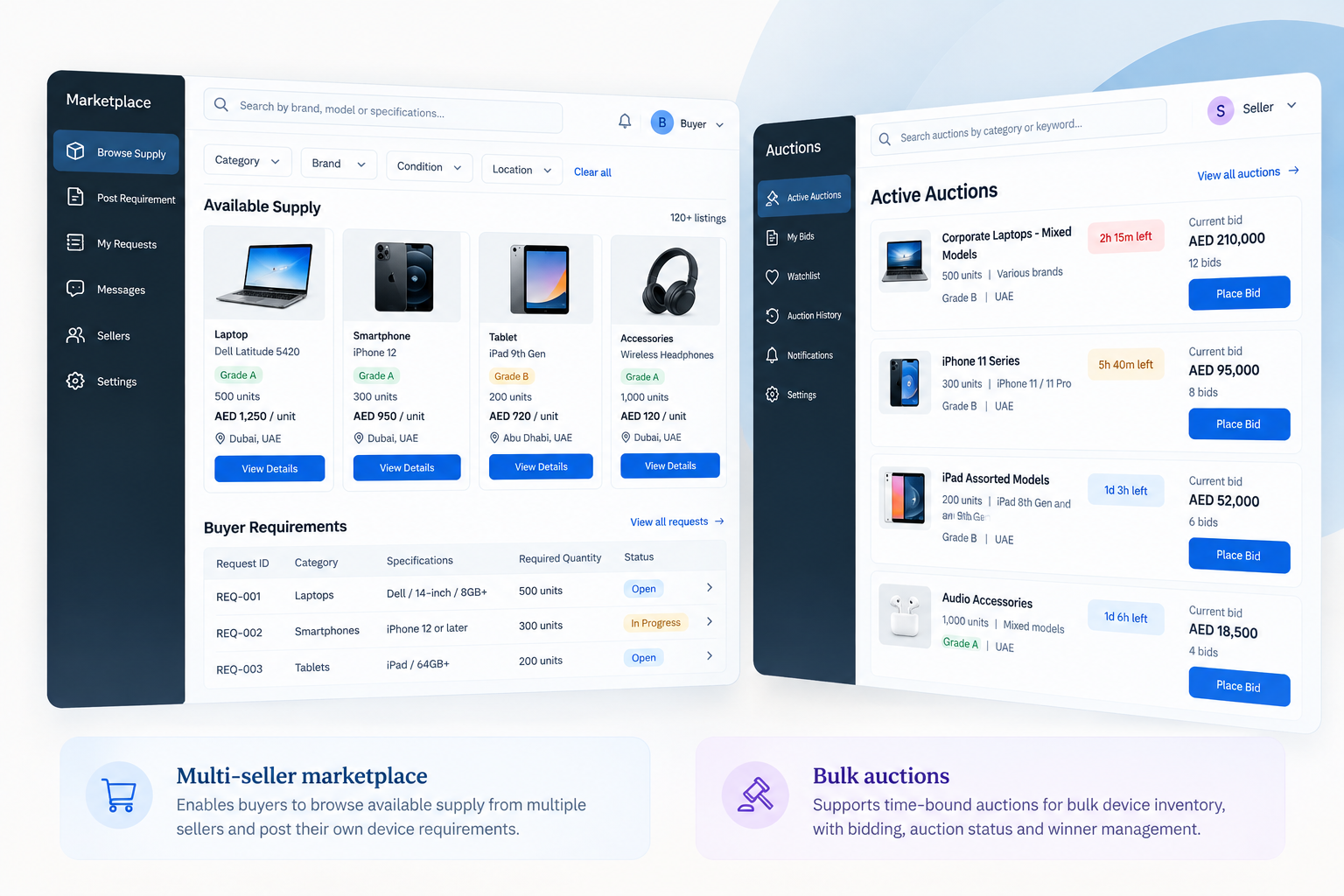
Conceptual illustration of the two proposed B2B platforms. Not actual client interfaces.
- Role
- Product Manager / Product Owner
- Team
- Product Head · Product Manager · UX/UI Designer · Client Business Team
- Project type
- Short-term product definition initiative
- Focus
- Discovery · Requirements · User Journeys · Design Collaboration · PRD · Handover
01
The opportunity
The business was exploring two new B2B platforms to expand how buyers and sellers could transact in the secondary-device market.
One platform was focused on ongoing multi-seller procurement, allowing buyers to discover available supply or post requirements and connect with multiple sellers.
The second was focused on bulk auctions, enabling larger inventory lots to be offered through competitive bidding.
Although the two products served different buying scenarios, both required clear user journeys, defined marketplace rules, operational processes and a practical MVP scope.
02
Two products, two buying problems
Multi-seller marketplace
Bulk auctions
- Primary need
- Multi-seller marketplaceOngoing procurement
- Bulk auctionsBulk inventory liquidation
- Buyer behaviour
- Multi-seller marketplaceBrowse available supply or post requirements
- Bulk auctionsDiscover lots and participate in competitive bidding
- Supply model
- Multi-seller marketplaceOngoing inventory
- Bulk auctionsEvent-driven bulk inventory
- Product focus
- Multi-seller marketplaceReplenishment and structured procurement
- Bulk auctionsCompetitive auction experience
Although both products connected buyers and sellers, they addressed fundamentally different transaction scenarios and therefore required different user journeys, rules and product experiences.
03
My role
My involvement focused on taking the initial business opportunity through discovery, product definition, design collaboration and structured product requirements.
Product discovery & definition
- Participated in discovery sessions with the business team to understand the opportunity, users and requirements.
- Translated business needs into product requirements and helped define the scope for the two platforms.
- Worked through user journeys, workflows and functional requirements across the marketplace and auction experiences.
- Contributed to defining the MVP scope and documenting future considerations.
Design collaboration
- Explained the business and product scope to the UX/UI designer.
- Walked through intended user journeys and functional requirements.
- Reviewed proposed UX/UI designs with the designer.
- Discussed product behaviour and provided feedback as the experience evolved.
- Worked collaboratively with the designer to refine the proposed experience.
PRD & handover
- Created and refined Product Requirements Documents for the platforms.
- Documented functional scope, workflows and product requirements for the client's internal development team.
- Refined the Auctions PRD through multiple iterations, including functional scope, the single live auction round, and Operations and Finance processes.
- Prepared the product definition for handover.
04
Defining the user journeys
The product journeys were shaped around the different transaction models rather than forcing both products into the same marketplace experience.
Multi-seller marketplace
Available supply
Buyer browses available inventoryevaluates relevant supplyprogresses towards procurement
Post requirement
Buyer specifies a requirementrelevant seller responsesbuyer evaluates available options
The product therefore needed to support both discovery of existing supply and active demand creation.
Bulk auctions
- 01
Discover auction
- 02
Review lot
- 03
Participate in live bidding
- 04
Track bid status
- 05
Auction outcome
The auction experience required a different interaction model built around discovery, lot evaluation, competitive bidding and clear bid-status feedback.
05
Shaping the MVP
The next step was translating the core journeys into a practical initial product scope while separating essential capabilities from future possibilities.
Multi-seller marketplace
- Buyer requirements and available supply
- Seller offers
- Matching and deal-making
- Order lifecycle
- Supplier participation
- Operational processes
Bulk auctions
- Enterprise sellers creating bulk lots
- Timed auctions
- A single live competitive bidding round
- Multiple winners where applicable
- Auction discovery for buyers
- Real-time bidding
- Support for multiple auctions
Potential future capabilities were kept separate from the initial scope so the first product definition remained focused.
- 01
Understand the problem
- 02
Define the core journey
- 03
Shape the MVP
- 04
Separate future scope
06
UX & Product Collaboration
The UX/UI was developed collaboratively between product and design.
My role was to translate the product scope and requirements into a clear direction for the designer — explaining the user journeys, expected behaviour and functional requirements behind the experience.
The designer then translated those requirements into UX/UI designs. We reviewed the designs together, discussed how the experience should work, and iterated based on product and usability considerations.
- 01
Product scope & requirements
- 02
Explain user journey & expected behaviour
- 03
Designer develops UX/UI
- 04
Review & discussion
- 05
Product feedback & refinement
- 06
UX/UI reflected in product requirements
Conceptual collaboration flow.
This collaboration helped connect the business problem, user journey and product requirements while keeping design ownership with the UX/UI specialist.
07
From discovery to PRD
The final stage of my involvement was bringing the product thinking together into structured Product Requirements Documents for both platforms.
The PRDs captured the product scope, user journeys, functional requirements, business rules, operational considerations and agreed product experience, providing a clear reference for the client's internal development team.
For the Auctions platform in particular, the requirements evolved through several iterations as the product definition became clearer. My documented updates included expanding the functional scope, refining the experience around a single live auction round, and incorporating Operations and Finance processes.
- 01
Discovery
- 02
Requirements
- 03
User Journeys
- 04
Design Collaboration
- 05
PRD
- 06
Handover
The PRD was the output of the product-definition process — not the product work itself.
08
Handover
Because development was handled by the client's internal team, the endpoint of my involvement was product definition and handover rather than development or launch.
The completed product requirements and supporting UX/UI designs provided the internal team with a structured reference for taking the two platforms forward.
My involvement concluded with
- Finalising and refining the product requirements.
- Ensuring agreed workflows, functional requirements and business processes were captured.
- Aligning the documented requirements with the UX/UI developed collaboratively with the designer.
- Handing over the product definition for the client's internal team to continue with development.
09
What I learned
Different transaction models require different product experiences.
Although both products connected buyers and sellers, continuous procurement and competitive auctions required different journeys, rules and interactions.
Product and design need to evolve together.
Working closely with the designer helped translate complex marketplace requirements into clearer user experiences, while design discussions also helped identify areas where product behaviour needed further clarification.
A good PRD captures decisions, not just features.
Documenting user journeys, business rules, operational processes, scope boundaries and future considerations made the PRD a useful handover artifact rather than simply a feature list.