Case study 02
Custom Order Management System
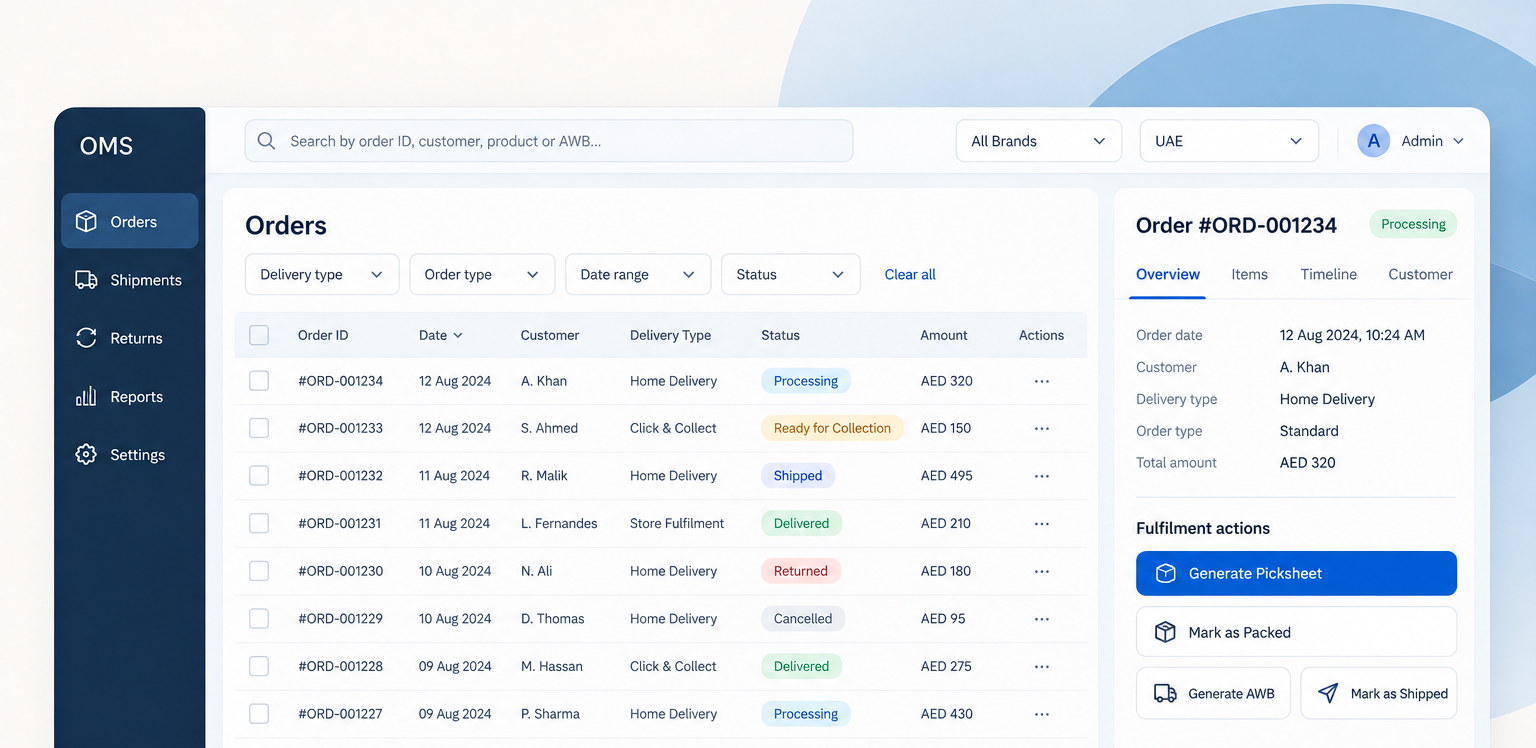
A centralised platform for managing orders, fulfilment, delivery, returns and store operations
- Role
- Product Manager / Product Owner
- Team
- Product, business, operations, fulfilment, engineering and external partners
- Timeline
- Long-term product initiative
- Focus
- Product discovery · Requirements · Workflow design · Integrations · UAT · Launch · Continuous enhancement
01
The challenge
The business, operations and fulfilment teams did not have a common place to view and manage orders.
They were relying on the backend of the customer-facing platform, which was difficult for some users to navigate and created a risk of unintended changes.
As the business operated across multiple brands and regions, the teams needed a dedicated operational system that could provide a clearer view of orders and support the full order lifecycle.
02
The product opportunity
The opportunity was to create a dedicated Order Management System that would give operations, fulfilment and customer care teams a single place to manage and track orders.
Visibility
- Brand- and region-based order views
- Filtering by delivery type, order type and date
- Live order-status visibility for customer care
- Operational reporting
Fulfilment & delivery
- Order lifecycle management
- Picksheet generation and packing workflows
- AWB generation, shipping and delivery tracking
- Automated routing based on order and product type, with orders routed to delivery partners according to defined quotas
- Click & Collect order management
Returns, payments & communication
- Returns and cancellations management
- Payment settlement after shipment
- Refund processing for returns and cancellations
- Automated customer order communications
03
My role
As Product Manager / Product Owner, I was responsible for driving the product from discovery through launch and continued enhancement, working under a Head of Product.
Product discovery & definition
- Led discovery sessions with business, operations and fulfilment stakeholders.
- Gathered and clarified requirements across different user groups and operational processes.
- Defined process workflows and translated them into epics, user stories and acceptance criteria.
- Managed and prioritised the Jira product backlog and facilitated story grooming.
Cross-functional delivery
- Worked closely with engineering and business stakeholders throughout the delivery lifecycle.
- Actively participated in Scrum ceremonies and facilitated Scrum activities where required.
- Coordinated discussions and requirements for third-party integrations and worked with external vendors.
- Facilitated integration discussions across SAP ERP, the customer-facing platform and other connected systems.
Testing & launch
- Actively participated in product testing and validation.
- Managed UAT with business stakeholders.
- Coordinated the product through launch and post-production support.
- Continued to manage enhancements and fine-tuning after the initial launch.
04
How the OMS worked
Primary fulfilment path
- Order created
- Processing
- Packing
- Shipping
- Delivery
Click & Collect path
- Order created
- Processing
- Ready for collection
- Collected
Conditional workflows
Cancellation or return Refund, where applicable
Conceptual product workflow — simplified to illustrate the operational lifecycle.
The OMS brought together order visibility, fulfilment, delivery, store operations, returns and payment-related processes into a single operational product.
05
Key operational workflows
- Order visibility
- Teams could view orders across multiple brands and regions and filter them based on relevant operational criteria.
- Fulfilment & delivery
- The system supported picksheet generation, packing, AWB generation, shipment processing, delivery tracking and delivery-status updates.
- Routing
- Automated routing logic helped determine the appropriate delivery partner based on order type, product type and defined delivery-partner quotas.
- Returns & cancellations
- Returns and cancellations were managed within the OMS, with payment integration supporting the relevant refund processes.
- Click & Collect
- Store teams could manage Click & Collect orders, mark orders as ready for collection, mark orders as collected, and accept returns of online orders when customers returned them to a store.
- Customer care
- Customer care agents could access live order information directly rather than waiting for updates from operations.
- Payments
- The OMS was integrated with the payment gateway to support settlement after shipment and refunds for returns and cancellations.
06
Integrations & ecosystem
Conceptual product ecosystem
- Customer-facing platform
- SAP ERP
- CRM
- POS
- Payment gateway
- Delivery partners
- Email / SMS services
Illustrative view of the systems and external services involved; not the client's technical architecture.
07
Testing, UAT & launch
- 01
Discovery
- 02
Requirements
- 03
Development
- 04
Testing
- 05
Business UAT
- 06
Launch
- 07
Continuous enhancement
The product was validated through active testing and business UAT before launch. I coordinated with stakeholders and delivery teams throughout the process and continued to support the product after production, including enhancements and fine-tuning.
08
Outcome
The OMS was successfully launched and gave operations and fulfilment teams a dedicated place to manage and track orders across brands and regions.
By bringing order visibility, fulfilment workflows, delivery tracking and operational reporting into one system, the product helped reduce operational workload and make order management more structured and efficient.
Customer care teams were also able to access live order information directly rather than waiting for updates from operations.
09
Continued product evolution
- Launch
- Operational feedback
- Enhancements
- Fine-tuning
The OMS continued to evolve after launch rather than remaining a fixed implementation. The team added enhancements and new capabilities based on operational needs, including additional reporting and picksheet-generation functionality, along with ongoing workflow improvements and fine-tuning.
10
What I learned
- 1Complex operational products need workflows that work across different teams, not just individual features.
- 2Integration requirements need to be understood from the perspective of the business process and user journey, not only the systems involved.
- 3Launch is the beginning of product evolution; operational feedback and real-world usage continue to shape priorities and improvements.