Case study 01
AI-Powered Search
Making website information easier to discover
- Role
- Product Manager / Product Owner
- Team
- 1 Developer · 1 DevOps Engineer · 1 Tester · Product
- Timeline
- Approximately 3–4 weeks
- Focus
- Product definition · Requirements · UAT · Delivery
01
The challenge
The organization had substantial website content, but finding relevant information was not always straightforward through conventional keyword search. Visitors might not know the exact terminology used in the site's content.
02
The product opportunity
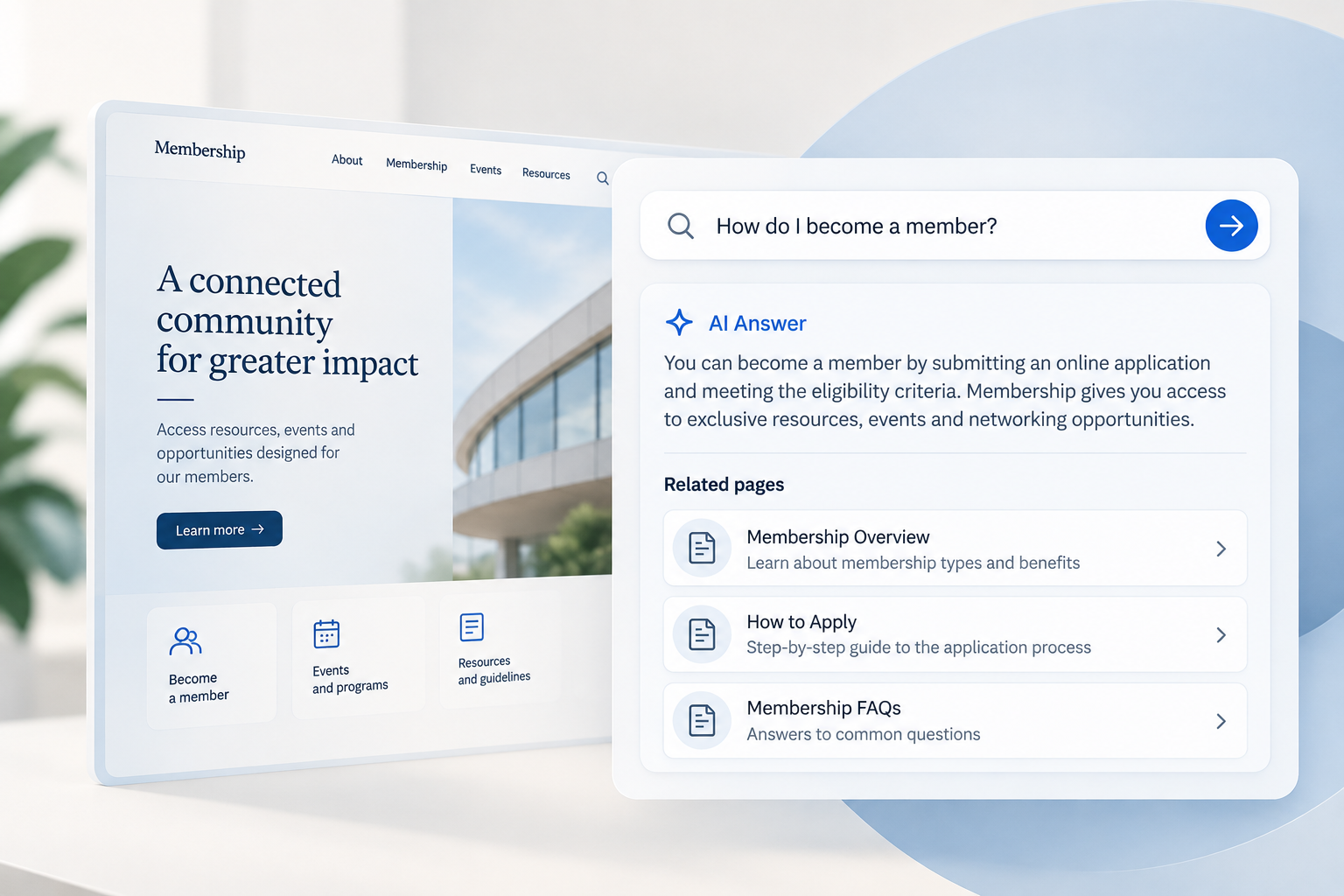
The opportunity was to make website information easier to discover by creating an AI-powered search experience that could interpret a visitor's question, retrieve relevant website content, generate a contextual response, and link visitors back to the original source pages.
03
My role
I worked between the client, the delivery team and design — defining what the experience should do, making sure it was built and presented as intended, and validating it before and after launch.
Define
- Discussed expected functionality and requirements with the client.
- Clarified the intended user experience and expected behaviour.
- Translated agreed requirements into user stories and acceptance criteria.
- Coordinated required service subscriptions with the client.
Shape
- Worked with the development team around the proposed solution and intended experience.
- Discussed how AI search results should be presented with the UX designer, who translated those discussions into the final interface design.
Validate
- Supported the internal demo.
- Participated in business UAT.
- Personally tested queries and results.
- Coordinated testing with the tester and developer.
Deliver
- Supported delivery and launch.
- Contributed to post-launch refinement.
04
How the experience worked
- 01
Website content
- 02
Content processing & retrieval
- 03
AI-generated summary
- 04
Links to original source pages
Simplified product workflow — focused on the user-facing product experience rather than technical architecture.
05
Testing & validation
- 01
Internal demo
- 02
Business UAT
- 03
Query & result testing
- 04
Launch
Feedback from the internal demo and business UAT shaped improvements before launch. I personally tested queries and results, and coordinated testing with the tester and developer.
06
After launch
- 01
Launch
- 02
Observe
- 03
Identify issue
- 04
Fix
- 05
Refine
Once the experience was available to website visitors, a repeated fallback-image issue was identified, where the same fallback image appeared across multiple search results. The issue was investigated and a quick fix was implemented.
07
Outcome
The AI-powered search experience was successfully launched and received positive feedback from the client.
The repeated fallback-image issue was identified and resolved after launch.
08
What's next
A second phase was discussed to extend search beyond the organization's own website. This was deferred until appropriate external reference sources could be provided — a product dependency that remains a future opportunity.
09
What I learned
- Defining the intended user experience clearly matters when translating an emerging technology into a usable product.
- Validation needs to cover real user queries and end-to-end results, not only the expected happy path.
- Refinement continues after launch, as real usage reveals issues that may not appear during initial validation.